
What are the main types of tea?

Protected-origin rules restrict the name “Longjing” to three zones inside Zhejiang Province:
- Xihu (West Lake) District —the 168 km² core area around Hangzhou’s West Lake township.
- Qiantang District —covering Xiaoshan, Yuhang, Fuyang, Lin’an, Tonglu, Jiande and Chun’an counties.
- Yuezhou District —Shaoxing, Xinchang, Shengzhou, Zhuji plus parts of Shangyu, Pan’an, Dongyang and Tiantai.
Only leaf picked inside the Xihu core may be sold as “West Lake Longjing” (Xihu Longjing). Everything else is simply “Longjing tea.”
West Lake Longjing – the gold standard
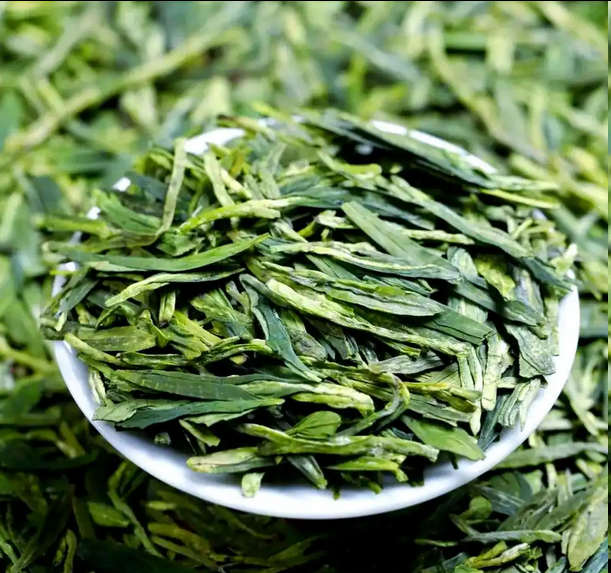
Leaf: flat, sleek, arrow-straight, 20–25 mm long, ±4 mm wide; tender green to jade.
Aroma: rich, floral, “high and lasting.”
Liquor: apricot-green, crystal bright.
Taste: mellow, sweet, fresh, with a hint of bean or chestnut.
Infused leaf: tender green, complete single buds with one or two just-unfolding leaves.
Micro-lots from the five historic villages—Longjing, Wengjiashan, Manjuelong, Lingyin and Meijiawu—trade at the highest premiums.

Major non-lake styles you’ll meet on the marke
Dafeng Longjing (Xinchang County)
- Wider, slightly yellower flakes; pronounced “fire-work” scent; 3,500 t yearly output.
- Good value, consistently clean taste, but lacks the subtle sweetness of true West Lake leaf.
Shengzhou Longjing (Shengzhou City)
- Picked one notch finer; style mimics West Lake but prices run 30–50 % lower.
- Output tops 4,000 t—more than the entire Xihu core.
Shopping checklist – what to look for in 30 seconds
- Shape
Old-zone craft: razor-flat, silky surface, perfect length-to-width ratio.
New-zone leaf: often bowed, rough, too narrow or too broad, visible white down. - Hairs (or lack thereof)
West Lake Longjing is made from small-leaf cultivars (Longjing Qunti or Longjing 43). Pick standard is one bud + one (sometimes two) just-opening leaves; NO single-bud “needle” versions. If you see an all-bud “Longjing,” it isn’t from the lake. - Colour
Core: fresh jade green with a faint yellow cast under strong light.
Dafeng: stronger yellow tinge.
Shengzhou: slightly bluer green. - Aroma in the bag
Shake a 5 g sample in a pre-warmed gaiwan. West Lake gives a gentle, orchid-chestnut bouquet; Dafeng shouts with bake-dry “fire” notes; cheaper Qiantang lots can smell grassy or even dusty. - Infusion test
Use 3 g, 150 ml, 80 °C water, 90 s.
- West Lake: bright apricot-green; sweet, rounded, almost no astringency; swallow and a cool sensation appears at the back of the throat.
- Dafeng: deeper green liquor, stronger roast character, slight dryness on finish.
- Generic Qiantang: lighter fragrance, thinner body, sometimes a raw-green bite.
Price reality check (spring 2024 pre-Qingming pick)
- Top-village West Lake: ¥3,000–8,000 / 500 g at farm gate.
- Secondary Xihu townships: ¥1,200–2,500 / 500 g.
- Dafeng superior grade: ¥400–800 / 500 g.
- Shengzhou specialty: ¥300–700 / 500 g.
If a vendor offers “West Lake Longjing” below ¥800 / 500 g before May, be skeptical—either the leaf is blended, or the geography is wrong.
Storage tip
Keep airtight, away from light, below 25 °C and <60 % RH. West Lake Longjing is prized for its fresh aroma; buy only what you’ll drink in six months, or vacuum-seal and freeze in 25 g packets.
Use this cheat-sheet and you’ll never again pay premium prices for second-tier leaf—or mistake a single-bud green “needle” for the real, flat-jade arrow that is true West Lake Longjing.